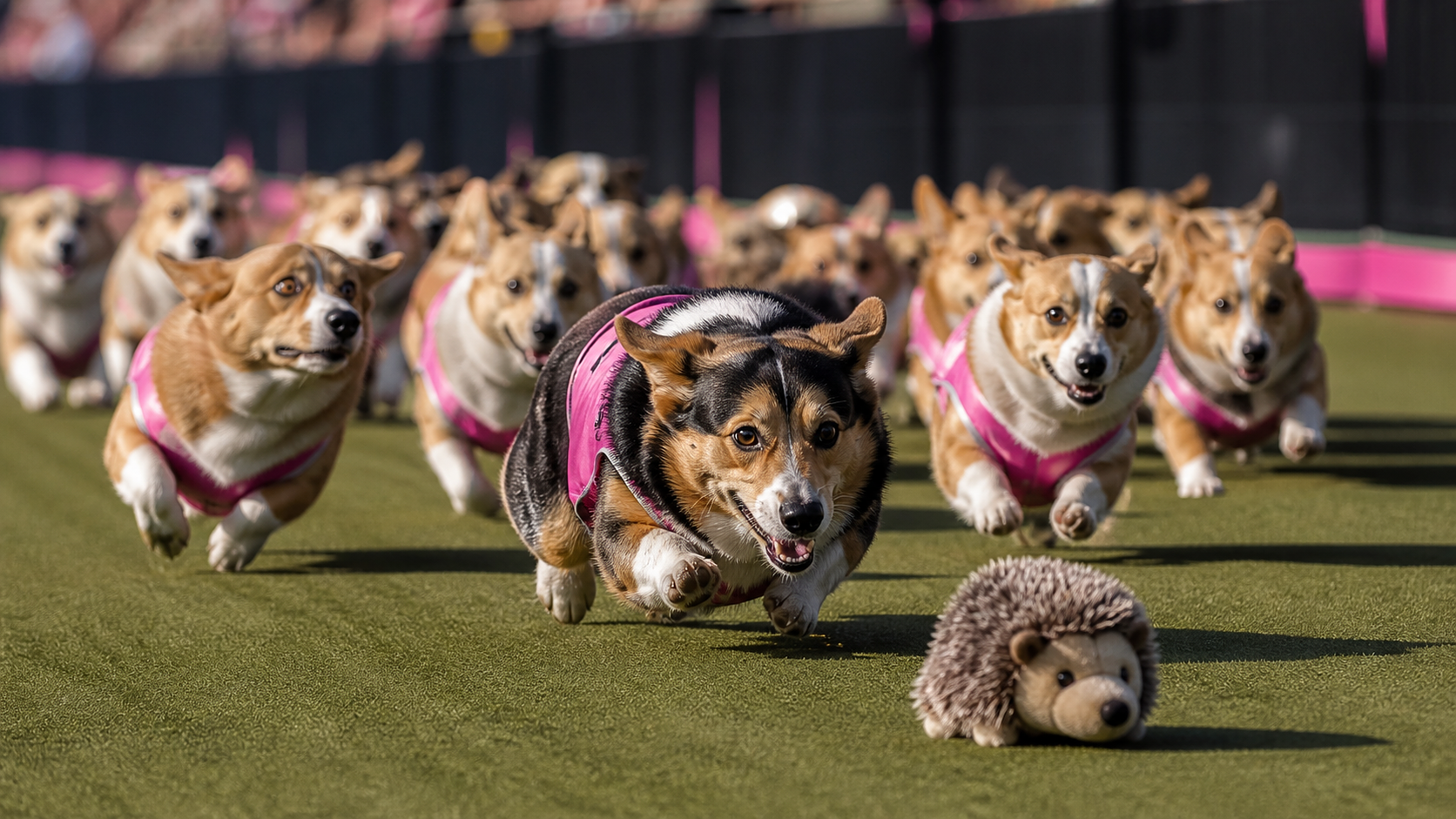
I have been told, repeatedly, by men, that corgi racing is not a sport.
I would like those men to stand at the rail at Pemberton Downs on a Saturday in August, in the third heat, when the gate goes up and forty-one pounds of Welsh cattle dog launch themselves down a hundred feet of artificial turf toward a dead squeaky hedgehog on a fishing line, and tell me — look me directly in my face and tell me — that this is not the purest athletic expression available to us in this fallen century.
You cannot. Nobody can. I have asked eleven people and two of them cried.
Let me set the scene, because the scene is everything.
There are fourteen dogs on the card. The favorite is a tricolor named Winston Churchill's Revenge, four years old, out of a breeder in Ocala, and he has won six straight. He does not look at the other dogs. He does not look at anything. He stares at the middle distance like a man who has already seen the outcome and found it tedious. His owner, a retired orthodontist named Gary, has a tattoo of him on his calf. I asked Gary if the tattoo was of Winston. Gary said, "It's of what Winston represents." I did not follow up. I did not need to.
The long shot is a red-and-white two-year-old called Sourdough, 40-to-1, who spent the entire pre-race parade attempting to eat a wasp.
You already know who I bet on.
The mechanics of corgi racing are simple and therefore devastating. There are no hurdles, because there cannot be hurdles. There are no turns, because a corgi taking a turn at speed is essentially a loaf of bread being thrown sideways out of a moving vehicle, and the insurance situation is what it is. There is only the straightaway. There is only the lure. There is only the terrible physics of a dog with the torso of a dachshund and the ambition of a thoroughbred.
They are built entirely wrong for this. That is the point. That has always been the point. Show me another sport where the athlete's own body is the primary antagonist and I will show you a liar.
The gate goes up at 2:47 PM.
What happens next is not running. Running implies a relationship with the ground that these animals have declined. What happens is closer to a controlled fall — front legs reaching, back legs firing in a frantic blur, ears pinned flat, the whole undercarriage of the dog approximately four inches above the earth and staying there through sheer refusal. Twelve of the fourteen go straight. One immediately turns and attempts to leave the venue. One sits down.
Winston Churchill's Revenge takes the lead at thirty feet and never surrenders it. He crosses in 6.81 seconds, catches the hedgehog, kills it thoroughly, and then — I want to be precise here, because this is the part I will be thinking about on my deathbed — he looks up into the crowd. Not at Gary. At the crowd. At all of us. The way a soloist looks up after the final note.
Sourdough finishes eleventh. Sourdough is thrilled. Sourdough has, by any measure that matters, had the best afternoon of anyone present, myself included, and I was drinking.
I lost forty dollars. I would lose it again. I would lose considerably more.
Here is what I know now that I did not know at noon: every other sport is about the gap between what an athlete can do and what a human being can do. Corgi racing is about the gap between what a body can do and what a soul has decided it will do anyway, and the body losing that argument at 6.81 seconds a hundred feet.
The card runs again next Saturday. I have already requested the credential. I have already told my editor. My editor has already stopped responding.
See you at the rail.
Mabel Barkley is a new contributor. This is her first assignment. It was supposed to be four hundred words.